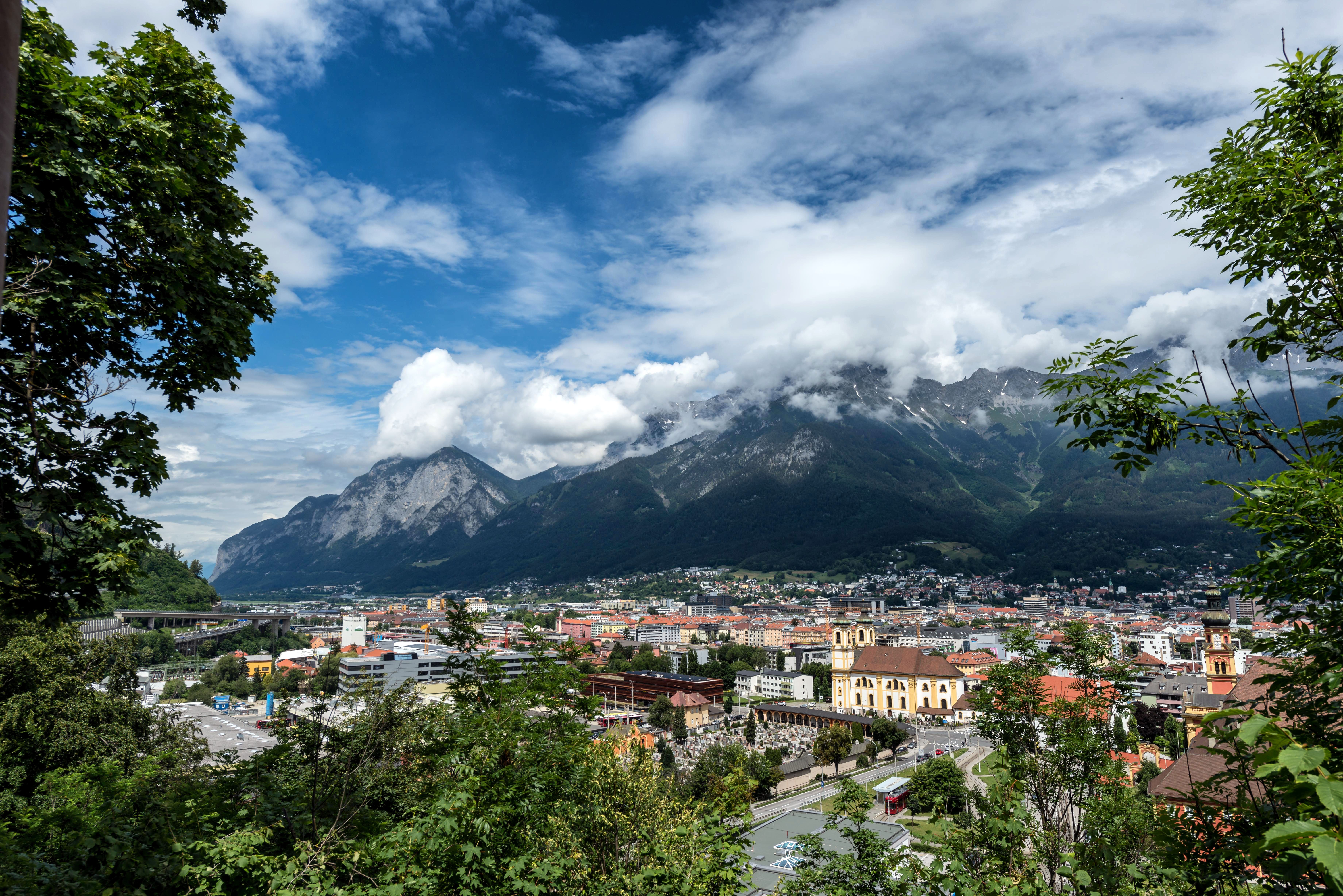
Innsbruck
Urban RiverfrontInnsbruck emerged as a major Alpine city during the Renaissance, when it served as the capital of Tyrol under Emperor Maximilian I, and that historical significance shaped its identity for centuries. Today it's a vibrant mountain city in western Austria, straddling the Inn River in a valley surrounded by dramatic peaks. The old town retains its medieval character with narrow lanes, colorful facades, and the iconic Golden Roof—a Renaissance landmark that draws visitors from across Europe. Beyond the historic core, Innsbruck functions as a modern university city and winter sports hub, hosting the 1964 and 1976 Winter Olympics. The surrounding mountains offer year-round recreation: skiing and snowboarding in winter, hiking and mountain biking in summer. The city balances its role as a tourist destination with genuine local life—cafes, restaurants, and cultural venues serve both visitors and residents. Its position as a gateway between Italy and Germany, combined with excellent public transport and proximity to pristine Alpine terrain, makes it a natural hub for anyone drawn to mountain living.
 PassportCard Expat Health Insurance
Get Quote
Never worry about paying your medical bills out of pocket again. The innovative PassportCard allows for a stress-free experience for all expat families, remote travelers, and workers. With a 24/7 customer service and an outstanding customer base of over 2 Million clients, it will feel like medical care at home. Get up to 10% off on your policy now.
PassportCard Expat Health InsuranceNever worry about paying your medical bills out of pocket again. The innovative PassportCard allows for a stress-free experience for all expat families, remote travelers, and workers. With a 24/7 customer service and an outstanding customer base of over 2 Million clients, it will feel like medical care at home. Get up to 10% off on your policy now.
Get Quote
Visa & Residency
Obtaining a residency in Austria involves several steps and the process can be somewhat complex, depending on the type of visa and the applicant's circumstances. The Red-White-Red Card is a popular option for skilled workers from third countries. It is based on a points system that considers factors such as professional qualifications, work experience, language skills, and age. To apply, one must have a job offer in Austria that corresponds with their qualifications. The application process involves gathering necessary documents, such as proof of accommodation, health insurance, and a no criminal record certificate, and submitting them to the Austrian embassy or consulate in one's home country or directly to the Austrian authorities if legally residing in Austria. Another option for expats is the Family Reunification Visa, which allows family members of Austrian residents to live in Austria. The main requirement is proof of a family relationship, such as marriage or parenthood, with an Austrian resident. For those who do not qualify for the Red-White-Red Card or Family Reunification Visa, there are other types of permits such as the Student Visa or the Job Seeker Visa. The Job Seeker Visa allows individuals to enter Austria for six months to look for work. If they find a job that meets certain criteria, they can then apply for a Red-White-Red Card. The process can be challenging due to the need for accurate documentation and navigating the legal requirements. It is advisable to start the application process well in advance of the intended move date and to consult with the Austrian embassy or a legal expert specializing in Austrian law. The difficulty of the process can vary greatly depending on the individual's situation and preparedness. However, Austria has a well-defined immigration system, and with the correct preparation, obtaining a residency visa is a manageable task for most expats.
Cost of Living
Living costs in Innsbruck sit in the moderate range for Austria, though prices have climbed in recent years as the city attracts more international residents and remote workers. Rent for a central apartment runs higher than smaller Austrian towns but remains reasonable compared to Vienna or major Western European cities. Groceries, dining, and utilities are fairly standard for the Alpine region, though proximity to ski resorts and tourist infrastructure does push some prices upward.
Weather
Innsbruck experiences a continental Alpine climate with cold, snowy winters and mild summers. The valley location means weather can shift rapidly, and the surrounding peaks influence local conditions significantly.
Healthcare in Innsbruck
Universitätsklinik Innsbruck is the region's major medical center with comprehensive services and research facilities. The city has multiple smaller clinics and private practices, and healthcare quality meets Austrian standards, which are high. English-speaking doctors are available, particularly at the university hospital.
Schools in Innsbruck
Innsbruck has several international options including the International School of Innsbruck (ISI), which offers the International Baccalaureate curriculum from primary through secondary levels. The school draws expat families and follows English-language instruction with German language integration.
Multiple bilingual schools operate in Innsbruck, primarily offering German-English instruction at both primary and secondary levels. These schools serve families seeking dual-language education while maintaining strong ties to the Austrian curriculum.
Restaurants in Innsbruck