siem reap
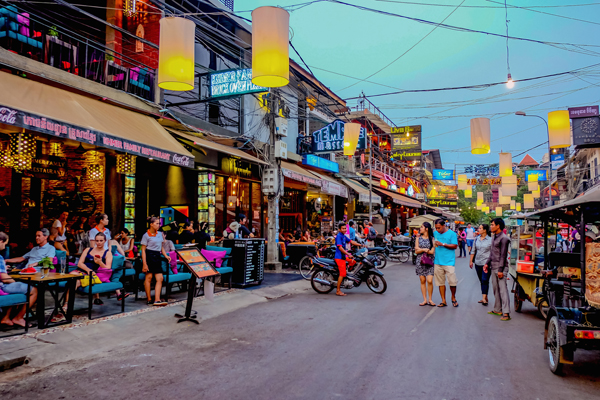
Country RiverfrontSiem Reap is a city in northwestern Cambodia that has transformed from a quiet provincial town into Southeast Asia's most visited destination, driven almost entirely by proximity to Angkor Wat. The first thing visitors notice is the sheer density of temples—not just the famous complex but hundreds of smaller sanctuaries scattered through the surrounding countryside, many still being excavated and restored. The city itself sits on the Siem Reap River, which floods seasonally and shapes both the landscape and local life. Downtown centers on a compact grid of colonial-era streets, now lined with guesthouses, restaurants, and tour operators catering to the roughly two million annual visitors. The wet season (May to October) turns the region into a patchwork of flooded rice paddies and swollen waterways; the dry season (November to April) brings dust and crowds. Beyond the temple circuit, Siem Reap has developed a secondary identity as a hub for NGO work, artisan workshops, and culinary tourism. The city's growth has been rapid and uneven—luxury resorts and backpacker hostels exist in close proximity, sometimes on the same street. Local Khmer culture persists in markets, silk workshops, and traditional dance performances, though tourism has reshaped much of what visitors encounter. The surrounding region includes floating villages, mangrove forests, and smaller archaeological sites that offer alternatives to the main temple complex.
 AGS Worldwide Movers
Get Quote
Relocating abroad soon? Make your move with AGS! AGS Worldwide Movers is a leader in the international moving industry. Our experience and expertise allows us to guarantee our clients the best quality moving services.
AGS Worldwide MoversRelocating abroad soon? Make your move with AGS! AGS Worldwide Movers is a leader in the international moving industry. Our experience and expertise allows us to guarantee our clients the best quality moving services.
Get Quote
Visa & Residency
Obtaining a residency in Cambodia is a process that can be straightforward if the applicant is well-prepared with the necessary documents and understands the requirements. The most common type of visa for expats seeking long-term residency is the Ordinary Visa, also known as the E class visa. Upon arrival in Cambodia, expats can apply for an E class visa directly at the airport or at any other entry point. This visa is initially valid for 30 days and can be extended within the country. To extend the Ordinary Visa, expats must choose from one of the following options: EB Visa for business and employment, EG Visa for those seeking employment or who are in between jobs, ER Visa for retirees, and ES Visa for students. The extension process requires expats to present relevant documentation, such as a letter of employment for the EB Visa or proof of retirement income for the ER Visa. The extensions can be for one, three, six, or twelve months; however, only the six and twelve-month extensions allow for multiple entries. The difficulty of the process largely depends on the type of visa extension an expat applies for. For example, the EB Visa requires a work permit, which involves additional paperwork and a separate application process. On the other hand, the ER Visa for retirees may be less complicated, provided that the applicant can demonstrate sufficient funds or a pension. It is important to note that while the process is manageable, it often requires the assistance of a local agent or agency that specializes in visa services, as they can help navigate the nuances of the Cambodian system. Fees for these services and the visa extensions themselves vary, and it is advisable to budget for these costs. Overall, while there may be some bureaucratic hurdles and the need for proper documentation, the process of obtaining a residency visa in Cambodia is considered average in terms of difficulty. Expats who are prepared and seek local assistance when necessary can successfully obtain residency in Cambodia.
Cost of Living
Daily expenses in Siem Reap are among the lowest in Southeast Asia. A meal at a local restaurant costs $2–4 USD, while Western-style dining runs $8–15. Guesthouse rooms range from $5–15 per night for budget options to $30–60 for mid-range comfort. Long-term rentals for expats typically start around $300–500 monthly for a modest apartment, though prices rise significantly in newer developments and resort areas catering to tourists.
Weather
Siem Reap has a tropical monsoon climate with a pronounced wet season from May to October and a dry season from November to April. Temperatures remain hot year-round, typically between 25–35°C (77–95°F), with humidity highest during the rainy months.
Healthcare in siem reap
Siem Reap Provincial Hospital serves as the primary public facility, though it operates with limited equipment and staffing constraints typical of provincial Cambodia. Private clinics and smaller hospitals like Angkor Hospital for Children and Royal Angkor International Hospital offer better-equipped services and English-speaking staff, primarily for expatriates and tourists willing to pay premium rates. Serious medical emergencies typically require evacuation to Bangkok or Phnom Penh.
Schools in siem reap
Siem Reap International School (SRIS) operates an IB curriculum from primary through secondary, drawing expat families across Southeast Asia. Angkor International School offers American-style education with English-medium instruction. Both schools maintain modern facilities and employ internationally credentialed teachers, though tuition runs $8,000–$18,000 annually.
Several Khmer-English bilingual programs operate at the primary level, including Cambodian-run institutions that blend local curriculum with English language instruction. Quality and consistency vary significantly between schools; expat parents typically verify current accreditation and teacher qualifications directly rather than relying on published credentials.
Restaurants in siem reap