Split
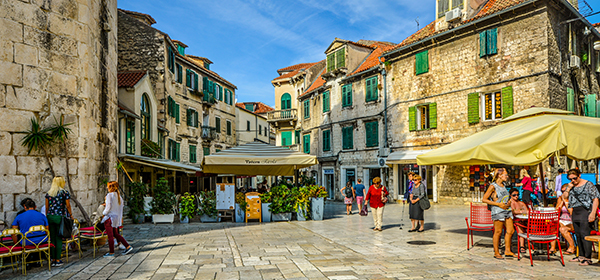
Urban Coastal BeachesWalk along the Riva waterfront at sunset and you'll see why Split has always been a crossroads. The Adriatic laps at limestone quays where fishing boats still tie up beside modern yachts, and behind them rises the old town—a dense warren of narrow streets built literally into and around the walls of Diocletian's Palace, a 4th-century Roman structure that forms the city's beating heart. Split is Croatia's second-largest city and the gateway to the Dalmatian coast, a place where ancient stone architecture meets contemporary Mediterranean life. The palace itself isn't a museum piece cordoned off from daily existence; it's woven into the fabric of the city, with apartments, shops, and restaurants occupying spaces that have been continuously inhabited for nearly two millennia. Beyond the palace, Split sprawls across a peninsula with a working harbor, tree-lined squares, and a mix of Austro-Hungarian and Yugoslav-era buildings reflecting its complex history. The city pulses with a particular energy—younger than Dubrovnik to the south, less polished, more lived-in. It's a real working port and university town, not primarily a tourist stage, though tourism has grown substantially. The surrounding region offers immediate access to island-hopping, hiking, and water sports, making Split both a destination in itself and a practical base for exploring the Dalmatian archipelago.
 SJB Global
Connect
SJB-Global is a top-rated financial advisory firm specializing in expat financial advice worldwide, offering retirement planning & tax-efficient solutions with a regressive fee model. Our clients benefit from their country’s most favorable tax environment by utilizing the efficient investment vehicles we offer. Our commitment to quality service is reflected in our stellar reviews, with over 300 testimonials boasting 95% five-star ratings.
Click connect to have our partner contact you via e-mail and/or phone.
SJB GlobalSJB-Global is a top-rated financial advisory firm specializing in expat financial advice worldwide, offering retirement planning & tax-efficient solutions with a regressive fee model. Our clients benefit from their country’s most favorable tax environment by utilizing the efficient investment vehicles we offer. Our commitment to quality service is reflected in our stellar reviews, with over 300 testimonials boasting 95% five-star ratings.
Connect
Click connect to have our partner contact you via e-mail and/or phone.
Visa & Residency
Obtaining a residency in Croatia involves several steps and can be considered an average challenge for expats. The process begins with determining the appropriate type of visa. The most common types are the Temporary Stay Visa and the Permanent Stay Visa. For temporary stays, expats must apply before entering Croatia at the nearest Croatian embassy or consulate. The application requires various documents, including a valid passport, proof of health insurance, evidence of sufficient funds to support the stay, and a purpose for the stay, such as work, study, or family reunification. For those interested in permanent residency, applicants must have held temporary residency for five years before applying. The Permanent Stay Visa requires additional documentation, such as proof of integration into the Croatian society, which may include language proficiency and social connections. Digital nomads can apply for the Temporary Stay Visa specifically designed for them. This visa was introduced to attract remote workers and is valid for up to one year. Applicants must provide proof of their status as digital nomads, which typically means showing they work remotely for a company or clients outside of Croatia. They must also have health insurance and show they have the financial means to support themselves without taking local employment. The difficulty of the process can vary based on the applicant's nationality, the completeness of their application, and their specific circumstances. It is advisable to start the application process well in advance of the intended move date, as processing times can vary. Additionally, laws and regulations may change, so staying informed about the latest requirements is crucial. Expats often benefit from consulting with legal experts or expatriates who have gone through the process. Overall, while there are several bureaucratic hurdles to clear, with proper preparation and documentation, obtaining a residency visa in Croatia is a manageable process for many expats.
Cost of Living
Split's cost of living sits comfortably in the moderate range for a European coastal city. Dining out, groceries, and local services remain affordable compared to Western European standards, though prices have climbed noticeably in the old town and waterfront areas catering to tourists. Accommodation is the variable—renting a small apartment in the center costs more than in residential neighborhoods, and property purchase prices have risen as international interest in the city has grown, yet remain lower than comparable Mediterranean destinations.
Weather
Split enjoys a Mediterranean climate with hot, dry summers and mild winters; expect abundant sunshine year-round, with July and August typically reaching the high 80s Fahrenheit, while winter temperatures rarely drop below freezing.
Healthcare in Split
Splitska bolnica (Split Hospital) is the region's primary medical facility, offering emergency care, surgery, and specialized departments with equipment meeting European standards. English-speaking staff availability is inconsistent outside major departments; routine care and prescriptions are accessible through private clinics and pharmacies concentrated near the city center.
Schools in Split
Split hosts several international schools including the International School of Split, which offers IB programs, and British-curriculum options. These schools primarily serve expat families and Croatian students seeking English-language education, with enrollment typically ranging from preschool through secondary levels.
Bilingual education in Split centers on English-Croatian instruction, available at select private institutions and some public schools offering enhanced language programs. The availability and depth of bilingual curricula varies by school, with stronger options concentrated in central Split.
Restaurants in Split