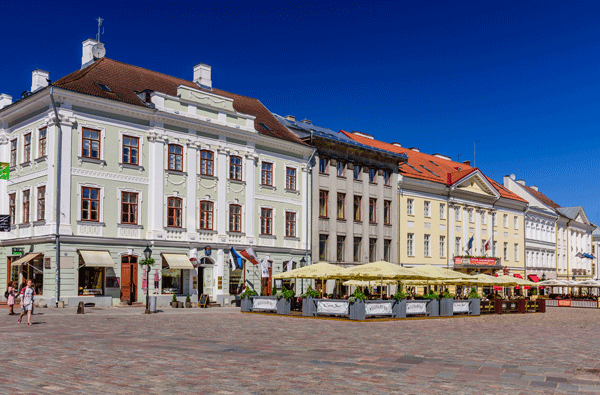
Tartu
Urban RiverfrontTartu sits on the Emajõgi River in southern Estonia, a university city where medieval spires rise above tree-lined squares and the intellectual pulse of student life animates the streets. The old town's pastel-colored buildings cluster around Toompea Hill, where the ruins of a 13th-century cathedral overlook the Emajõgi's gentle flow. This is Estonia's second-largest city, but it moves at a different tempo than Tallinn—less tourist machinery, more genuine engagement with ideas. The university, founded in 1632, anchors the city's identity; its presence shapes everything from the bookshops and cafes to the cultural events that fill the calendar. Tartu's museums, including the Estonian National Museum and the University of Tartu Museum, offer windows into the region's layered past. The city has rebuilt itself multiple times—most recently after Soviet occupation—and carries that resilience in its architecture and spirit. Summer brings outdoor markets and riverside walks; winter transforms the landscape into something stark and contemplative. Tartu functions as a genuine living city rather than a heritage display, where locals outnumber visitors and the rhythm follows academic calendars and seasonal shifts.
 BlueCross BlueShield Global Solutions
Get Quote
BlueCross BlueShield Global Solutions (BCBS) offers global health plans for international assignments or trips lasting 6 months or longer. With access to over 1.7M medical providers in 190 countries around the world, BCBS provides members with solutions and industry-leading digital services - ensuring top-quality coverage to people who live, work, study and travel internationally.
BlueCross BlueShield Global SolutionsBlueCross BlueShield Global Solutions (BCBS) offers global health plans for international assignments or trips lasting 6 months or longer. With access to over 1.7M medical providers in 190 countries around the world, BCBS provides members with solutions and industry-leading digital services - ensuring top-quality coverage to people who live, work, study and travel internationally.
Get Quote
Visa & Residency
Obtaining a residency in Estonia involves several steps and can be considered an average challenge compared to other countries. Expats looking to reside in Estonia typically apply for a Temporary Residence Permit or a Long-Stay (D) Visa. The Temporary Residence Permit is suitable for those who intend to stay longer than 90 days and can be granted for various reasons such as work, study, business, or for family reasons. The application process involves submitting a filled-out application form, a valid travel document, a photo, and documents proving the purpose of stay, such as a work contract or a letter from an educational institution. Additionally, applicants must provide proof of legal income, health insurance, and may need to pass an Estonian language test depending on the basis of their application. For digital nomads, Estonia has introduced a Digital Nomad Visa which allows remote workers to live in Estonia and legally work for their employer or their own company registered abroad. This visa can be issued for a short stay of up to 90 days or a long stay of up to 1 year. To qualify, applicants must prove that they can perform their work duties regardless of location and have a stable income of at least €3504 (gross of tax) per month for the six months preceding the application. The process for both types of visas requires thorough preparation and attention to detail when gathering the necessary documentation. Applicants must submit their applications either at an Estonian Embassy or Consulate or, if legally in Estonia, at the Police and Border Guard Board. It is important to note that the processing time can take several months, so it is advisable to apply well in advance of the planned move. Overall, while the process is bureaucratic and requires various proofs and documentation, it is generally well-structured and manageable for those who meet the criteria.
Cost of Living
Compared to Western European cities and even Tallinn, Tartu remains affordable. Rent for a one-bedroom apartment in the city center runs considerably less than in major Western capitals, and groceries, dining, and entertainment follow suit. The student population keeps prices grounded—landlords and businesses price with student budgets in mind. Property ownership and long-term living costs remain accessible for those relocating from higher-cost regions.
Weather
Tartu experiences a temperate continental climate with cold, snowy winters and mild summers; expect temperatures ranging from below freezing in winter to around 20°C (68°F) in summer, with significant daylight variation between seasons.
Healthcare in Tartu
Tartu University Hospital (Tartu Ülikooli Kliinikum) is Estonia's second-largest medical facility with comprehensive departments and emergency care. English-speaking staff availability varies; basic care is reliable, though specialized procedures may require Tallinn referrals.
Schools in Tartu
Tartu has limited but functional international options. Tartu English College offers an English-medium curriculum through secondary level. The International School of Tartu (IST) provides IB-aligned education, though enrollment remains modest compared to Tallinn schools.
Several Estonian public schools operate bilingual tracks, particularly in English and Russian. Tartu Kivilinna School and Tartu Miksike School offer parallel Estonian-English instruction streams from primary grades onward.
Restaurants in Tartu