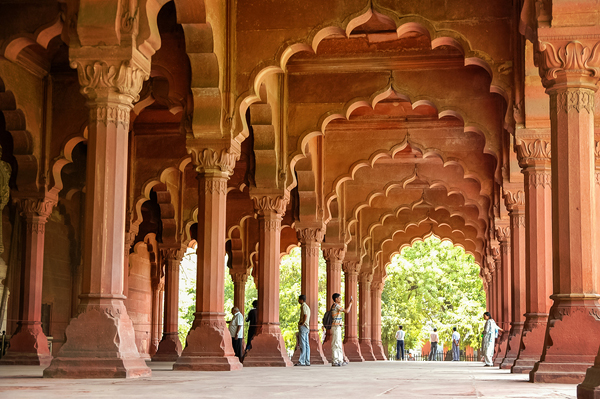

New Delhi
Urban RiverfrontNew Delhi became India's capital in 1931, replacing Kolkata as the seat of government during the British Raj. British architect Edwin Lutyens designed the city's grand boulevards and administrative core, creating wide tree-lined avenues and neoclassical buildings that still define its character today. Since independence in 1947, New Delhi has evolved into a sprawling metropolis of over 30 million people across the National Capital Region, blending Lutyens's colonial geometry with dense residential neighborhoods, markets, and modern commercial districts. The city pulses with political power—Parliament House, the President's residence, and countless ministry buildings anchor its identity as India's nerve center. Beyond government, New Delhi is a cultural and commercial hub where ancient monuments like the Red Fort and Jama Masjid stand amid contemporary shopping malls and tech parks. Traffic congestion and air quality challenges are persistent realities, especially in winter months when crop burning in neighboring states compounds pollution. Yet the city remains magnetic for opportunity seekers, students, and professionals drawn to its economic dynamism and cosmopolitan energy.

SJB GlobalConnect
SJB-Global is a top-rated financial advisory firm specializing in expat financial advice worldwide, offering retirement planning & tax-efficient solutions with a regressive fee model. Our clients benefit from their country’s most favorable tax environment by utilizing the efficient investment vehicles we offer. Our commitment to quality service is reflected in our stellar reviews, with over 300 testimonials boasting 95% five-star ratings.
Click connect to have our partner contact you via e-mail and/or phone.
SJB GlobalSJB-Global is a top-rated financial advisory firm specializing in expat financial advice worldwide, offering retirement planning & tax-efficient solutions with a regressive fee model. Our clients benefit from their country’s most favorable tax environment by utilizing the efficient investment vehicles we offer. Our commitment to quality service is reflected in our stellar reviews, with over 300 testimonials boasting 95% five-star ratings.
Connect
Click connect to have our partner contact you via e-mail and/or phone.
Visa & Residency
Obtaining a residency in India involves several steps and the process can vary depending on the type of visa applied for. The most common types of visas for expats seeking residency are the Employment Visa and the Entry (X) Visa. The Employment Visa is designed for foreigners who are taking up employment in India. To qualify, applicants must have a job offer from an Indian company and the salary must exceed a certain threshold. The application process involves submitting a visa application form, passport-sized photographs, a valid passport, proof of employment, and the requisite fee. The Entry (X) Visa is for individuals of Indian origin and their family members, as well as for those coming to India for volunteer work or to accompany a spouse or family member who is in India on a long-term visa, such as an Employment Visa. The process for obtaining these visas typically starts with filling out an online application form and scheduling an appointment at the nearest Indian consulate or embassy. Applicants must provide various documents, including a passport with at least six months' validity, passport-sized photographs, and supporting documents relevant to the type of visa, such as a job offer letter for an Employment Visa or proof of Indian origin for an Entry (X) Visa. The difficulty of the process can vary based on the applicant's nationality, the completeness of their application, and the specific requirements of the local Indian consulate or embassy. Generally, the process is considered average in terms of difficulty, but it can be time-consuming and requires attention to detail to ensure all requirements are met. Once the application is submitted, it is reviewed by the consulate or embassy, and if approved, the visa is stamped into the applicant's passport. The duration of the visa can vary; Employment Visas can be issued for the duration of the contract, up to a maximum of five years, while Entry (X) Visas can also be issued for up to five years and can be extended in India. It is important to note that all foreign nationals must register with the Foreigners Regional Registration Office (FRRO) within 14 days of arrival in India if they are planning to stay for more than 180 days.
Cost of Living
Living costs in New Delhi have climbed sharply over the past decade, particularly for housing in central and south Delhi neighborhoods where expats and affluent Indians concentrate. Rental prices for decent apartments rival those in major global cities, while dining out, private schooling, and imported goods command premium prices. Local markets and street food remain affordable, but middle-class and upper-middle-class lifestyles require substantial budgets.
Weather
New Delhi experiences a hot semi-arid climate with scorching summers (April–June) reaching 40–45°C, mild winters (December–February) around 10–15°C, and a monsoon season (July–September) bringing heavy rainfall and temporary relief from heat.
Healthcare in New Delhi
Apollo Hospitals, Max Healthcare, Fortis, and Indraprastha Apollo operate multi-specialty facilities with ICU capacity and English-speaking staff, concentrated in South and Central Delhi. Government hospitals like AIIMS Delhi provide advanced care at lower cost but face crowding and longer wait times. Private facilities cater to expat and affluent populations; public options serve the broader population with variable service quality.
Schools in New Delhi
Delhi has established international schools including The British School, Delhi Public School (DPS), and American Embassy School, most concentrated in South Delhi neighborhoods like Vasant Kunj and Greater Kailash. These follow IB, British, or American curricula and cater primarily to expat families, with tuition ranging from ₹20–40 lakh annually.
Hindi-English bilingual education is standard across most private schools in Delhi; schools like Springdales School and Pathways School explicitly emphasize dual-language instruction. Many CBSE-affiliated schools integrate Hindi as a mandatory subject alongside English medium instruction.