Florence
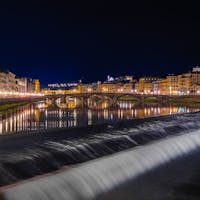
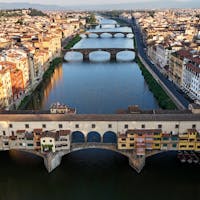
Urban RiverfrontFlorence sits on the Arno River in central Italy and serves as the capital of Tuscany, a region that produces some of the world's most celebrated wines and olive oils. The city is home to the Uffizi Gallery, one of the oldest and most important art museums in Europe, and the Florence Cathedral with its iconic dome designed by Brunelleschi—a feat of Renaissance engineering completed in 1436. Medieval streets radiate from the Ponte Vecchio, a bridge lined with jewelry shops that has spanned the Arno since the 14th century. Florence's economy historically centered on banking and the wool trade; the Medici family's financial power shaped not just the city but the entire Renaissance. Today, leather goods, textiles, and tourism drive the local economy. The city draws roughly 4 million visitors annually, making it one of Italy's most visited destinations. Beyond the major monuments, Florence offers smaller churches filled with frescoes, neighborhood markets selling produce and local products, and a walkable urban core where Renaissance palaces sit alongside contemporary galleries and restaurants. The surrounding hills of Tuscany—dotted with cypress trees, vineyards, and stone farmhouses—are easily accessible by car or train.
 SJB Global
Connect
SJB-Global is a top-rated financial advisory firm specializing in expat financial advice worldwide, offering retirement planning & tax-efficient solutions with a regressive fee model. Our clients benefit from their country’s most favorable tax environment by utilizing the efficient investment vehicles we offer. Our commitment to quality service is reflected in our stellar reviews, with over 300 testimonials boasting 95% five-star ratings.
Click connect to have our partner contact you via e-mail and/or phone.
SJB GlobalSJB-Global is a top-rated financial advisory firm specializing in expat financial advice worldwide, offering retirement planning & tax-efficient solutions with a regressive fee model. Our clients benefit from their country’s most favorable tax environment by utilizing the efficient investment vehicles we offer. Our commitment to quality service is reflected in our stellar reviews, with over 300 testimonials boasting 95% five-star ratings.
Connect
Click connect to have our partner contact you via e-mail and/or phone.
Visa & Residency
Obtaining a residency in Italy involves several steps and the process can vary depending on the type of visa you are applying for. The most common types of visas for expats include the Elective Residence Visa and the Work Visa. The Elective Residence Visa is designed for individuals who can prove they have a high, steady income from sources outside of Italy and do not need to work in the country. Applicants must show they have sufficient funds to support themselves, a place to live, and comprehensive health insurance. This visa is valid for one year and can be renewed. The Work Visa is for those who have secured a job in Italy before entering the country. The employer must apply for a work permit on behalf of the employee, which is subject to quotas. Once the work permit is granted, the employee can apply for the visa. This process can be quite competitive and time-consuming due to the quota system. Other visas include the Student Visa and Family Reunification Visa. The process generally involves gathering the required documentation, such as a valid passport, proof of financial means, accommodation, and health insurance, and submitting an application to the Italian consulate or embassy in your home country. An appointment is usually required, and you may need to attend an interview. The difficulty of the process can vary; it is often described as average, but it can be challenging due to the bureaucracy and strict requirements. It is advisable to start the application process well in advance of your intended move date and to seek assistance from professionals if necessary. Once in Italy, you will need to apply for a residence permit (permesso di soggiorno) within eight days of arrival to stay legally. This additional step involves going to the local post office or police station (Questura) to submit the necessary paperwork. Overall, while the process can be bureaucratic and requires careful preparation, it is manageable with the right planning and support.
Cost of Living
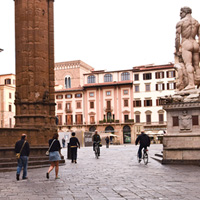
Florence's cost of living ranks among Italy's highest, driven by its status as a major tourist destination and cultural capital. Accommodation—whether rental apartments or hotel rooms—commands premium prices, especially in the historic center and near major attractions. Dining at restaurants catering to tourists can be expensive, though neighborhood trattorias and markets offer more affordable options for residents. Groceries and everyday goods are moderately priced compared to northern European cities, but overall expenses for housing and dining make Florence a costly choice for long-term residents.
Weather
Florence experiences a humid subtropical climate with hot, dry summers (often exceeding 30°C/86°F) and cool, wet winters with occasional frost. Spring and fall offer the most pleasant conditions for exploring the city.
Healthcare in Florence
Careggi Hospital, the primary public facility, operates as a teaching hospital affiliated with the University of Florence and handles trauma and complex cases. Private hospitals including Villa Medici and Ponte a Niccheri offer shorter wait times and English-speaking staff. Dental and specialist care are readily available through both public and private networks, though public system wait times can extend several weeks for non-urgent procedures.
Schools in Florence
Florence hosts several international schools including the International School of Florence (ISF), which follows the International Baccalaureate curriculum from preschool through grade 12, and the British School of Florence, offering a British-based education. These institutions serve expatriate families and Italian families seeking English-language instruction.
Bilingual schools in Florence operate primarily on Italian-English models, with institutions like Scuola Bilingue Fiorentina integrating both languages throughout the curriculum. Several private schools offer bilingual tracks alongside traditional Italian education, though availability and program depth vary by institution.
Restaurants in Florence