Luxembourg City
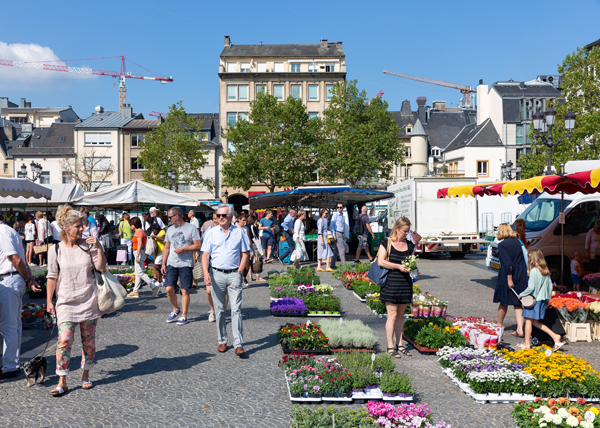
Urban RiverfrontLuxembourg City rises from a dramatic gorge carved by the Alzette River, its old town perched on sandstone cliffs that plunge nearly 60 meters below street level. Medieval fortifications still ring the upper plateau, their rust-colored stone walls visible from the valley floor, while modern glass towers cluster in the Kirchberg district across the river. The city functions as the capital of Luxembourg and one of the three official seats of the European Union, drawing diplomats, civil servants, and international professionals. Narrow cobbled lanes wind through the old town past Renaissance townhouses and baroque churches; the Grand Ducal Palace sits at the heart of civic life. The Grund, the lower town nestled in the river valley, pulses with restaurants and bars that spill onto terraces. Despite its outsized political importance, Luxembourg City remains compact—walkable in an afternoon—with a population under 130,000. The city blends medieval architecture with contemporary European institutions, creating an unusual rhythm where centuries-old streets lead to modern administrative complexes. Parks and green spaces punctuate the urban fabric, and the surrounding countryside of rolling hills and forests lies just beyond the city limits.
 BlueCross BlueShield Global Solutions
Get Quote
BlueCross BlueShield Global Solutions (BCBS) offers global health plans for international assignments or trips lasting 6 months or longer. With access to over 1.7M medical providers in 190 countries around the world, BCBS provides members with solutions and industry-leading digital services - ensuring top-quality coverage to people who live, work, study and travel internationally.
BlueCross BlueShield Global SolutionsBlueCross BlueShield Global Solutions (BCBS) offers global health plans for international assignments or trips lasting 6 months or longer. With access to over 1.7M medical providers in 190 countries around the world, BCBS provides members with solutions and industry-leading digital services - ensuring top-quality coverage to people who live, work, study and travel internationally.
Get Quote
Visa & Residency
Obtaining a residency in Luxembourg involves several steps and the process can vary depending on the applicant's nationality and the purpose of stay. For EU/EEA and Swiss nationals, the process is relatively straightforward. They do not need a visa to enter Luxembourg and can apply for a registration certificate upon arrival if they plan to stay for longer than three months. Non-EU/EEA nationals, however, must typically apply for a temporary authorization to stay (autorisation de séjour) from their home country before entering Luxembourg. This authorization is required for stays longer than 90 days. Once the authorization is granted, the individual can enter Luxembourg and must then declare their arrival at the local commune within three days. Following this, they must undergo a medical check-up and apply for a residence permit. The type of residence permit required depends on the individual's circumstances. For example, the EU Blue Card is aimed at highly skilled workers, while the Long-term Resident Permit is for those who have lived in Luxembourg for an uninterrupted period of five years. For digital nomads and other non-EU/EEA nationals seeking temporary residence, the Temporary Residence Permit is a common option. This permit is valid for one year and can be renewed as long as the conditions of the permit are still met. The application process for this permit includes providing proof of sufficient financial means, health insurance, and a clean criminal record. The difficulty of the process can vary. It is generally considered average, but it can be more challenging for those who do not have the necessary documents or who do not meet the specific criteria for their desired visa category. It is important to note that all documents submitted must be in French, German, or English, or be accompanied by a certified translation. Additionally, the Luxembourgish government encourages applicants to start the process well in advance of their planned move to Luxembourg due to processing times, which can take several months.
Cost of Living
Living in Luxembourg City ranks among Europe's most expensive. Rental prices for apartments in the old town or central districts command premium rates, while property purchase prices exceed most Western European capitals. Dining, utilities, and imported goods reflect the city's status as a wealthy financial and political hub, though salaries for EU and international workers often scale accordingly. Groceries and everyday services cost significantly more than in neighboring Belgium or France.
Weather
Luxembourg City experiences a temperate oceanic climate with cool, wet winters and mild summers; precipitation is fairly consistent throughout the year.
Healthcare in Luxembourg City
Centre Hospitalier de Luxembourg (CHL) is the primary public hospital, offering comprehensive emergency and specialist care with modern facilities and multilingual staff. Private clinics like Clinique Bel-Air provide alternatives for non-emergency procedures. Wait times for non-urgent care can extend several weeks through public channels.
Schools in Luxembourg City
The International School of Luxembourg (ISL) operates an IB curriculum from primary through secondary, drawing expat families across the EU institutions. Lycée Athénée Royal offers French-language secondary education with strong academic standing, while smaller options like the American School of Luxembourg serve English-speaking families, though capacity remains limited.
Luxembourg's public system inherently functions bilingually—Luxembourgish and French dominate primary education, with German introduced in secondary. Private bilingual programs like those at ISL blend English with French or German instruction, reflecting the country's trilingual workforce reality.
Restaurants in Luxembourg City