Kamakura
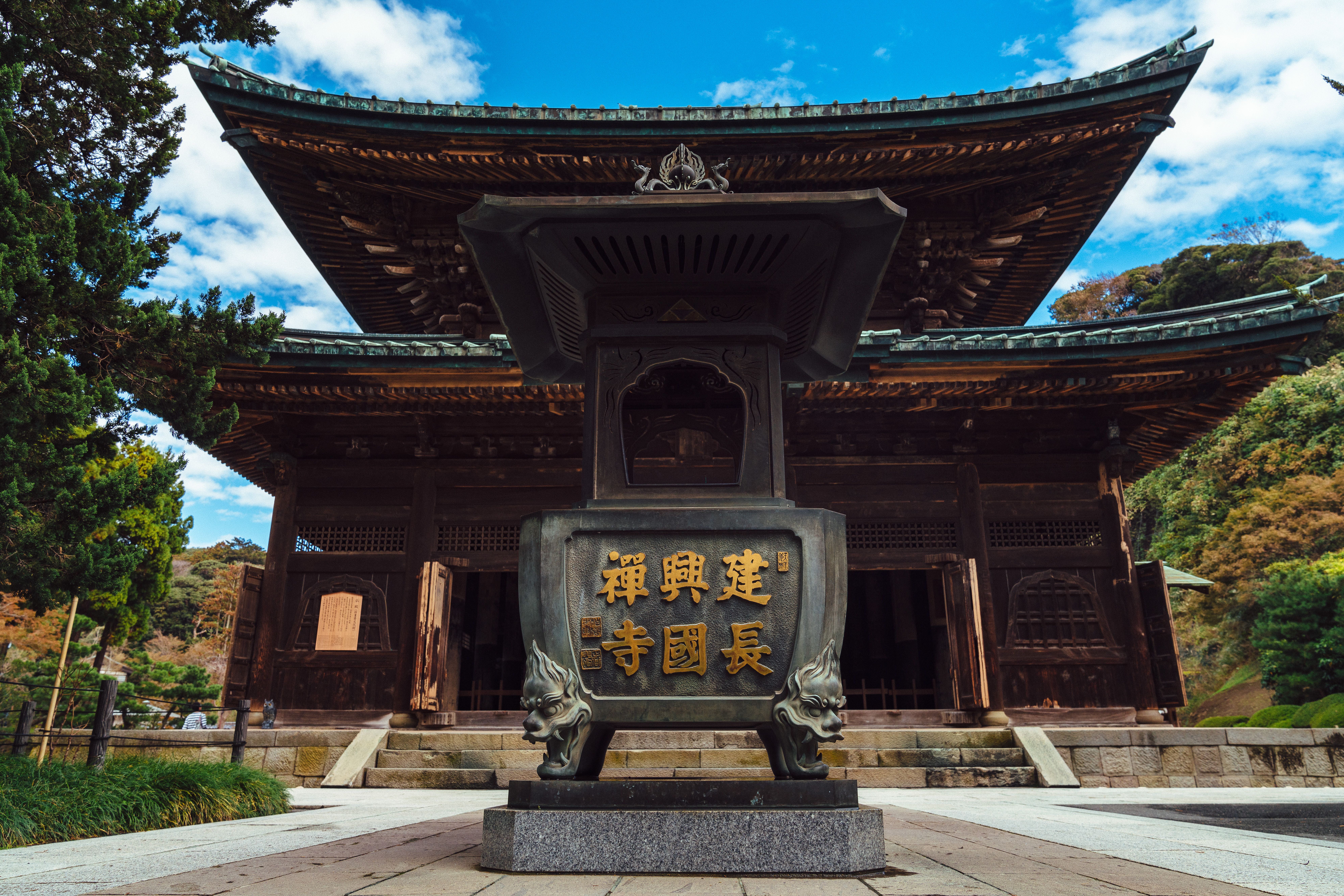
Suburban Coastal Beaches RiverfrontKamakura emerged in the late 12th century as Japan's first military capital under the Minamoto shogunate, a pivotal moment that shaped the nation's feudal structure for centuries. Though the seat of power moved to Kyoto and later Edo, Kamakura retained its spiritual and cultural significance. Today it remains a coastal town about an hour south of Tokyo, where samurai-era temples sit alongside sandy beaches and hiking trails through forested hills. The Great Buddha, cast in bronze over 750 years ago, still draws pilgrims and visitors to Kotoku-in temple. Beyond the major shrines and temples—Tsurugaoka Hachimangu, Kenchoji, Engakuji—Kamakura's quieter appeal lies in its walkable scale, the mix of residential neighborhoods with small shops and restaurants, and the way nature presses in from multiple directions. The town functions as both a living community and an open-air museum, where locals navigate daily life among historical sites rather than around them. Its proximity to Tokyo makes it accessible without feeling like an extension of the metropolis.
 SJB Global
Connect
SJB-Global is a top-rated financial advisory firm specializing in expat financial advice worldwide, offering retirement planning & tax-efficient solutions with a regressive fee model. Our clients benefit from their country’s most favorable tax environment by utilizing the efficient investment vehicles we offer. Our commitment to quality service is reflected in our stellar reviews, with over 300 testimonials boasting 95% five-star ratings.
Click connect to have our partner contact you via e-mail and/or phone.
SJB GlobalSJB-Global is a top-rated financial advisory firm specializing in expat financial advice worldwide, offering retirement planning & tax-efficient solutions with a regressive fee model. Our clients benefit from their country’s most favorable tax environment by utilizing the efficient investment vehicles we offer. Our commitment to quality service is reflected in our stellar reviews, with over 300 testimonials boasting 95% five-star ratings.
Connect
Click connect to have our partner contact you via e-mail and/or phone.
Visa & Residency
Obtaining a residency in Japan involves several steps and the process can be quite meticulous, but it is manageable with the right documentation and preparation. The most common types of residency visas include the Highly Skilled Professional Visa, which is aimed at attracting skilled foreign professionals in certain fields; the Working Visa, for those with job offers in Japan in various categories such as Engineer, Specialist in Humanities, or International Services; and the Spouse or Child of Japanese National Visa, for those who have a family connection to a Japanese citizen. The process typically starts with securing a job offer or sponsorship from a Japanese company or individual, which is necessary for most types of work-related visas. The sponsor in Japan will often assist in the application process and provide necessary documentation, such as a Certificate of Eligibility (COE), which is required to apply for the visa at a Japanese embassy or consulate in the applicant's home country. Applicants must submit the COE, a valid passport, visa application form, photograph, and any additional required documents specific to the type of visa they are applying for. The requirements can vary greatly depending on the visa category, so it is crucial to check the specific criteria for the chosen visa type. Once the application is submitted, it can take several weeks to several months for the Japanese authorities to process the visa. If approved, the applicant will receive a visa that allows them to enter Japan. Upon arrival, they must register their residence at the local municipal office and apply for a Residence Card, which is necessary for daily life in Japan. The difficulty of the process can vary based on the applicant's circumstances and the type of visa. Some visas, like the Highly Skilled Professional Visa, have a points-based system and require proof of advanced education and specialized skills. Others, like the Spouse or Child of Japanese National Visa, may have more straightforward criteria but still require substantial documentation to prove the family relationship. Overall, while the process is systematic and can be time-consuming, it is generally considered average in difficulty compared to other countries, provided that the applicant meets the eligibility criteria and has all the necessary documentation in order.
Cost of Living
Living in Kamakura costs more than rural Japan but considerably less than central Tokyo. Housing—both rental and purchase—reflects the town's desirability and historical character; older traditional homes are more affordable than newer construction, though renovation costs can add up. Dining and daily goods are reasonably priced, with a mix of local shops and convenience stores. The trade-off is that proximity to Tokyo and the quality-of-life appeal have steadily pushed prices upward over the past decade.
Weather
Kamakura has a humid subtropical climate with warm summers and mild winters, experiencing significant rainfall during the rainy season (tsuyu) in early summer and occasional typhoons in late summer and early fall.
Healthcare in Kamakura
Kamakura City Hospital provides general acute care and emergency services as the primary medical facility, supported by numerous private clinics distributed across residential areas. Dental and specialist practices are readily available, though residents requiring advanced tertiary care often travel to nearby Yokohama or Tokyo.
Schools in Kamakura
Kamakura hosts several international schools including Kamakura International School, which offers an English-language curriculum from kindergarten through grade 12. St. Maur International School, located nearby in Yokohama, serves the broader region and is accessible to Kamakura residents seeking IB and British-style education.
Bilingual education options exist through private institutions that blend Japanese and English instruction, though availability is more limited than in Tokyo. Most bilingual programs operate at the kindergarten and elementary levels, with fewer options at secondary education.
Local Schools
Restaurants in Kamakura